

International Student Health Plan Fee Increase
NOtice:
International Student Health Plan Fee Increase
This is a notice to all students covered under the International Student Health Plan offered by the Dalhousie Student Union (“the Union”) about a significant change to your fee for the 2026-2027 academic year. Beginning in September 2026, the following changes will be taking effect:
- The International Student Health Plan Single Student Fee will increase from $926.59 to $1328.84
- The International Student Health Plan Family Fee will increase from $1405.16 to $2195.05
- The International Companion Plan Fee will increase from $51.00 to $81.70
For further information on your coverage details, please consult www.studentvip.ca/dsu.
Why is the fee increasing?
The International Student Health Plan (IHP) has seen increased usage from students while the total pool of students in the Plan has been decreasing. This means the Union’s current International Health Plan Fund cannot sustainably cover the total costs of maintaining the Plan at the current fee levels. The coverage offered by the IHP also cannot be significantly changed to avoid a fee increase, as the Nova Scotia Provincial Government mandates a minimum coverage approximately equivalent to the provincial health plan coverage.
Despite the best efforts of the Union’s Health Plan team, this fee increase was necessary to ensure that the important coverage offered by the International Health Plan can remain in place to support international students. The decision to increase these fees was not taken lightly, and the Union has made best efforts to minimize the increase in costs experienced by international students.
Options for International Students
The Union is here to support international students through this change, and we encourage you to access the following resources if you require support:
- The International Student Emergency Bursary (ISEB) is a one-time bursary offered by the Union for international students experiencing an emergency financial need. More information and the application form can be found at https://www.dsu.ca/international-student-emergency-bursary.
- International students may choose to opt-out of the DSU International Health Plan. Please consult the opt-out requirements and deadlines on the Health Plan website (https://www.dsu.ca/health-plan) beforehand. The options for opt-out available are
o Private Opt-out: If you enroll or you are enrolled in a private insurance plan, you may be eligible for this opt-out method.
o Home Country Opt-out: If you’re completing your program from your home country, you may be eligible for this opt-out method.
o Sponsored Opt-out: If you are a student coming to Dalhousie with sponsored coverage from Saudi Arabia, you may be eligible for this opt-out method.
o MSI Opt-out: International students qualify for Nova Scotia’s provincial health plan (MSI) on the 1st day of the 13th month they have been in Canada. You may be eligible to opt-out by switching to this plan.
We at the Dalhousie Student Union remain committed to providing high-quality services and advocacy for international students at Dalhousie.
DSU President, Anjali Seshadri
DSU Iranian Student Solidarity Statement
DSU Iranian Student Solidarity Statement
The Dalhousie Iranian Student Society (DISS) has formally communicated concerns regarding the impact of the ongoing crisis in Iran on Iranian students at Dalhousie University to the DSU. On January 25, the DSU council voted to stand publicly in support of Iranian students, informed by the delegations from the Dalhousie Iranian Student Society.
We recognize the immense emotional, academic, financial and personal toll this crisis places on Iranian students, particularly those studying abroad who are worried for loved ones while navigating uncertainty and awaiting news from home. As students are frequently uniquely vulnerable to moments of crisis, we are particularly concerned about the impact this will have on Iranian students.
With internet shutdowns inside the country disrupting communication and increasing emotional distress among Iranian students, and with financial instability in Iran impairing families’ capacity to provide financial support, the DSU is concerned about Iranian students’ ability to meet academic and tuition deadlines. The DSU and DISS are advocating to Dalhousie University to provide academic and financial flexibility and accommodations in light of this crisis
Resources
In light of the ongoing crisis in Iran and its impact on students here at Dalhousie, we want to share a list of supports and resources that may be helpful if you’re experiencing stress, emotional difficulties, academic challenges, financial concern, or barriers to communication or documentation.
Mental Health and Emotional Support
Dalhousie Student Health & Wellness:
Counselling, wellness supports, same-day appointments, and referrals. You can find more information and book an appointment here: https://www.dal.ca/campus_life/health-and-wellness.htmlMental health services overview:
https://www.dal.ca/campus_life/health-and-wellness/my-health/mental-health.htmlSame-day counselling appointments:
https://www.dal.ca/campus_life/health-and-wellness/my-health/mental-health/same-day-counselling.htmlPeer Support Services:
Free, confidential peer-to-peer support on campus: https://www.dal.ca/campus_life/health-and-wellness/my-health/peer-support.html24/7 Crisis Lines (Nova Scotia): If you’re in urgent distress or need someone to talk to right now:
Nova Scotia Mental Health & Addictions Crisis Line:
902-429-8167 or toll-free 1-888-429-8167 (available 24/7)Good2Talk Nova Scotia (for post-secondary students):
Call 1-833-292-3698 text GOOD2TALKNS to 686868
Academic Advising and Flexibility
Academic Advising & Student Success Centre: Advising for course planning, deadlines, petitions, and academic challenges: https://www.dal.ca/campus_life/academic-support/advising.html
Halifax and Bissett Student Success Centre:
contact: https://www.dal.ca/campus_life/academic-support/advising/contact-us.htmlAdvisors can help discuss extensions, deferrals, and academic planning during difficult times.
Financial and Tuition-related Supports
We know financial strain can be very real when international money transfers are disrupted or costs increase unexpectedly.
International Student Emergency Bursary - DSU :
Emergency financial assistance available for international students experiencing unforeseen financial hardships, designed to help students continue their studies.
The bursary is reviewed case-by-case and intended to support students showing genuine need due to exceptional circumstances beyond their control.https://www.dsu.ca/international-student-emergency-bursary
Student Accounts & Financial Services:
Phone: 902-494-3998
Email: student.accounts@dal.ca
Office: Henry Hicks Building, Room 29, Halifax (for detailed questions about fees, payment options, payment deadlines, and receipts)The Student Accounts &Financial Services can be contacted to discuss tuition payment plans or options for meeting financial obligations.
Awards & Financial Aid Office (Dalhousie):
Dalhousie’s university bursary program may also offer support for students in financial need through the regular bursary application process:https://www.dal.ca/admissions/money_matters/awards-financial-aid/bursaries.html
Support with Immigration, Documentation, and Deadlines:
Students facing issues with visas, documentation, or communication disruptions should reach out to:
International Centre: Advises on immigration, study permit concerns, documentation delays, and may be able to support advocacy internally. Visit: https://www.dal.ca/campus_life/international-centre.html
Community and Peer Support:
Iranian Student Society: A peer community where students can share experiences and support one another.
Follow them on Instagram for more updates: https://www.instagram.com/diss_dal/
For students in Truro, the Student Success Centre has staff available: intdalac@dal.ca
DSU Statement on Dalhousie's Refusal to Divest

We are disappointed—but not surprised—by Dalhousie’s refusal to divest from companies complicit in the occupation of Palestine and the ongoing genocide in Gaza. Despite over a year of sustained advocacy, a detailed and evidence-based report, and overwhelming community support, the administration has chosen to ignore its moral and legal responsibilities.
On March 25, 2025, the Dalhousie Board of Governors—the same board whose members consistently sat in silence every time the DSU raised an issue regarding Palestine or Palestinian students—officially decided to reject the call for divestment. They did so through a vague, less-than-two-page report that fails to engage with the overwhelming evidence, moral clarity, and community demands presented over the past year. Nowhere in the report is the word “Palestine” or “Palestinians” even mentioned. The genocide, ethnic cleansing, and apartheid regime are reduced to vague “ongoing conflict in the Middle East,” erasing both the lived experiences of Palestinians and the crimes unfolding before our eyes by israel.
It is a shameful dismissal of a movement that brought students together across communities, built coalitions, presented evidence of Dalhousie’s complicity, and offered clear, actionable paths forward. Instead of engaging with the legal and ethical arguments we presented—including violations of international law and complicity in apartheid—Dalhousie’s leadership relied on vague ESG language, hollow legal consultations, and their fiduciary duty to maximize returns.
Dalhousie has once again demonstrated that it operates first and foremost as a business—not as an institution of education, social responsibility, or care. That was made even clearer this year with a tuition hike during a cost-of-living crisis and a hiring freeze that threatens academic quality and student support. Most recently, the Faculty of Management promoted an Israel exchange program to commerce co-op students, featuring activities like “wine tastings,” “camel rides,” and “floating in the Dead Sea” one day after israel violated the ceasefire agreement and killed another 500+ Palestinians. The program, described as a backup to take place in Nova Scotia and Ontario “in case we cannot travel to Israel,” clearly aims to whitewash settler colonialism while offering students a shallow and performative experience. That this was promoted during an active genocide is deeply disrespectful and reflects a disturbing normalization of killing and erasure.
We also want to highlight that the university’s claim to have updated its investment questionnaire with geopolitical questions came only after significant DSU pressure. These questions exist because of our work—because students demanded accountability and offered concrete ways to achieve it. That win should not be erased in the same report that tries to erase Palestine.
The divestment campaign is not going away. In fact, this dismissal only strengthens our resolve. Universities are not neutral. They choose what they fund, and they choose whose lives they value. We know which side Dalhousie has chosen today—but students, faculty, and communities will continue to fight for a university that reflects justice, accountability, and solidarity.
We want to thank every person who has been part of this movement—organizers, researchers, faculty, alumni, and encampment participants. You are the reason this conversation is even happening. Your work matters, and it will continue to matter far beyond this moment.
We are not done.
- The Dalhousie Student Union Executive Team
DSU's Response to Dalhousie's Recent Actions

We are compelled to address the alarming developments following Dalhousie’s latest communication regarding the Students for the Liberation of Palestine–Kjipuktuk (SLPK) encampment. On July 19th, the President’s Office issued an update outlining its commitments to the demands of the SLPK and the Dalhousie Student Union (DSU). This communication, framed as an agreement, unfortunately, lacks transparency and detail and fails to mention any clear commitment to divestment. Additionally, the outlined next steps failed to convey the urgency required to address the genocide in Palestine, even in light of the historic ruling by the International Court of Justice, which found multiple and serious violations of international law by Israel towards Palestinians and found Israel responsible for apartheid.
Despite the peaceful and educational nature of the student encampment, the university chose a path of escalation. On July 26th, an eviction notice was issued, demanding the dismantling of the encampment by the evening of July 28th. The enforcement of this directive, concluding in police involvement on July 29th, starkly contradicts the peaceful engagement and educational objectives the encampment consistently upheld.
This situation raises profound ethical and procedural concerns. Dalhousie's decision to use police force against its students not only infringes on the rights to free expression and peaceful assembly but also violates the very principles of Equity, Diversity, Inclusion, and Accessibility that the university claims to champion. This divergence from EDIA values, especially at a time when the university community needed them the most, undermines the trust and credibility Dalhousie has worked to build around these core commitments.
On July 29th, Dalhousie chose to close its Halifax campuses citing "safety concerns." However, the DSU contends that these alleged safety concerns are unfounded. Instead, the DSU argues that the real safety issues arose from the police's actions on that day, which included dismantling tents and disrupting the peaceful encampment established by the SLPK.
The SLPK encampment, known as Al-Zeitoun University, was a vibrant educational and community hub that included a library, medical and children's tents, and hosted numerous lectures and teach-ins, some of which were led by Dalhousie faculty members who have supported the SLPK and DSU's efforts since May. We believe that the SLPK initiatives significantly enriched the campus community and emphasized education and mutual support over conflict.
the DSU is deeply disappointed by the university administration's recent shift in approach. Having engaged in positive dialogue from the start of our advocacy, we were proud to be part of Dalhousie, an institution we believed supported meaningful student involvement. However, the recent events contradict the collaborative spirit we valued, severely undermining our trust in the university's leadership.
We call on Dalhousie University to build on the progress we have achieved together thus far. We urge the university not to shy away from our main demand for divestment. We are steadfast in our commitment and will not cease our efforts until meaningful change is enacted.
If you are experiencing distress or would like to discuss any concerns, please do not hesitate to contact the Executive team. We are here to support you and offer a space for open discussion.
In solidarity,
The DSU Executive Team

Dalhousie Student Union Statement Regarding the Dalhousie Campus Encampment Movement for Palestine
The Dalhousie Student Union (DSU) stands in solidarity with the Dalhousie students participating in the international campus encampment movement for Palestine. We endorse the Students for the Liberation of Palestine—Kjiputuk, affirming their rights to peaceful protest and freedom of expression at Dalhousie University…
Dalhousie Student Union Statement Regarding the Dalhousie Campus Encampment Movement for Palestine
The Dalhousie Student Union (DSU) stands in solidarity with the Dalhousie students participating in the international campus encampment movement for Palestine. We endorse the Students for the Liberation of Palestine—Kjiputuk, affirming their rights to peaceful protest and freedom of expression at Dalhousie University.
We believe in the power of advocacy and dialogue in fostering understanding and change. In response to the ongoing encampment and the approved DSU council motion for divestment, we are actively in dialogue with the university administration to ensure that the students' demands and voices are heard and addressed responsibly and respectfully.
As part of our ongoing support for the students participating in the encampment, we wish to remind all students that the facilities at the Student Union Building (SUB) are available for their use. This includes access to washrooms, shower rooms, vending machines, water fountains, first aid kits, the Loaded Ladle services, and our community fridge/pantry located in the basement of the SUB.
The DSU stands firmly against all forms of racism, discrimination, Islamophobia, and antisemitism. In alignment with the student protests against genocide, we unequivocally condemn all acts and ideologies of genocide. It is our clear and resolute position that genocide is a grievous violation of human rights, and we support all students who stand against such atrocities. Our dedication is to cultivate a campus culture that respects and celebrates diversity, upholds peace and justice, and encourages learning and growth.
We encourage all students to engage respectfully and thoughtfully with each other as this movement unfolds. If you’re feeling distressed, both the Dalhousie Health and Wellness Centre and our Executive offices are here to support you. Please don’t hesitate to reach out if you need assistance or someone to talk to.
Check out our Crisis Support and Information page on our website.
-The Dalhousie Student Union Executive Team

Dalhousie Student Union (DSU) Responds to the Nova Scotia 2023-24 Budget
Last Thursday, March 23rd, 2023, the Government of Nova Scotia released the 2023-24 Budget, which saw promising increases to priority areas, such as healthcare, immigration & skilled trades, and business. DSU Vice President Academic & External…
FOR IMMEDIATE RELEASE
March 27th, 2023
Dalhousie Student Union (DSU) Responds to the Nova Scotia 2023-24 Budget
Halifax, NS – Last Thursday, March 23rd, 2023, the Government of Nova Scotia released the 2023-24 Budget, which saw promising increases to priority areas, such as healthcare, immigration & skilled trades, and business. DSU Vice President Academic & External Sydney Keyamo represented the Dalhousie Student Union at the budget briefing, with attendance ranging from senior government officials to key stakeholders. The budget includes a $10 million investment in financial assistance to help students struggling with affordability; however, it fails to adequately address the growing inequities in student living expenses that necessitated this investment.
While we are glad to see increases to the Student Financial Assistance program in the provincial budget announcement, we await details confirming how this funding will be dispersed as well as how this funding will help sustainably maximize, or, at the very least, preserve access to postsecondary education regardless of income. In previous years, students have benefited from one-time subsidies and funding boosts during the COVID-19 pandemic, but these measures are not sustainable and leave students with a widening gap in their ability to access post-secondary education. Mechanisms such as increases in maximum assistance levels are one way to make sure that students have ongoing financial help, especially in wake of the reductions to the Canada Student Grants at the federal level. We also need to more fundamentally address a chronically underfunded postsecondary system.
Nova Scotia continues to have the highest tuition rates both within the Maritimes and in the country. Having experienced the greatest levels of inflation since 1982, students are under more financial strain than ever. Given that financial aid maximums have not been changed since 2017, and the cost of living has risen dramatically, nearly one in five students receiving financial help has been demonstrated to have unmet needs.
Students and university graduates play an essential role given that postsecondary education is a crucial driver of both population and economic growth. Despite this, the budget overlooks the importance of supporting students and graduates, which is especially alarming given the stark reductions in accessibility and affordability of post-secondary education within the past two years.
Students and graduates from all academic disciplines make significant contributions to the growth of the province's workforce. Paid work experience whilst studying has a substantial impact on labour force connection, while programs like Graduate to Opportunity help students with employment issues after graduation. Despite recent increases in demand, neither Graduate to Opportunity nor Co-operative Education programs received additional funds in the recent budget.
Although the budget may not have addressed many student concerns, we will continue to emphasize key issues such as housing, accessibility, and affordability, especially as we look ahead to the 2024 negotiations on the Memorandum of Understanding (MOU) between the province and its postsecondary institutions. We will continue to advance student concerns and ensure that all students can not only access post-secondary education, but also prosper and contribute back to their communities and province.
About the Dalhousie Students’ Union (DSU)
The Dalhousie Students’ Union (DSU) represents the collective voice and supports the diverse interests of over 20,000 students at Dalhousie University. The DSU supports over 250 student societies, builds community on campus through events, provides a range of essential student services and advocates for student rights to all levels of decision-makers within and beyond the University community.
For further information and media requests, please contact:
Arielle Simard
DSU Communications Coordinator, dsucomm@dal.ca
CC Sydney Keyamo
DSU Vice-President Academic & External, dsuvpae@dal.ca

DSU Statement on Homecoming Unsanctioned Gatherings
HALIFAX, Nova Scotia - On October 1st, 2022, students studying at Dalhousie University and other universities in the area attended unsanctioned street parties within the neighborhoods surrounding the university in honour of Homecoming…
The Dalhousie Student Union calls for on-campus Homecoming and action-oriented, proactive responses to yearly unsanctioned gatherings
HALIFAX, Nova Scotia - On October 1st, 2022, students studying at Dalhousie University and other universities in the area attended unsanctioned street parties within the neighborhoods surrounding the university in honour of Homecoming.
Large unsanctioned gatherings during late September and early October in honour of Homecoming first began affecting the Dalhousie community in 2017 and have become a yearly occurrence since. For those who attend, the parties are a cultural staple that reinforce their sense of identity and belonging. For those in our impacted neighborhoods, the parties are disruptive both to their peace & quiet as well as their property. For all, the parties result in significant community safety concerns and breakdowns in community relations. It is worth noting the role of social media influencers like Canadian Party Life in fueling the extremes we have seen. We also want to emphasize that these yearly unsanctioned gatherings are part of a broader issue affecting other university communities across the country.
Given the impact these events have had on the community, we would like to outline some of the discussions we have had with Dalhousie University and community stakeholders leading up to October 2022. We continue to advocate for a proactive and action-oriented response that includes an on- campus sanctioned Homecoming celebration hosted by the Dalhousie Student Union in collaboration with Dalhousie University.
During the summer, the DSU participated in several consultations to discuss the last unsanctioned street parties that occurred in 2021, and outline a plan for mitigating community impact in future years. This space consisted of key stakeholders including student leaders, neighbours, representatives from Keep it Social, members of Dalhousie Administration and staff, and members of the Dalhousie Student Union. Representatives from Halifax Regional Police and Halifax Regional Municipality were notably absent.
In early August, Canadian Party Life announced the date for the off-campus Homecoming party on their social media account. Not long after, the DSU reached out to Dalhousie University to propose co-hosting an on-campus sanctioned Homecoming celebration that would feature an outdoor concert, licensed drinking area, and on-campus harm-reduction supports. However, due to funding restrictions from the university, we were unable to host this event.
In response to the announcement, Dalhousie University sent two campus-wide emails discouraging students from attending the event. This email was intended to warn the campus community of the event, but instead students reported it served as free publicity to those who were unaware of the unsanctioned party and Canadian Party Life prior to these notices.
Although we recognize the programming organized by the university during the day on October 1st, we strongly believe that given the amount of notice both Dalhousie University and the City of Halifax had regarding the event, more comprehensive actions could have been taken. Sending emails to deter students from gathering, as well as implementing city bylaws to prevent small BIPOC family-owned businesses from operating after 11:00pm, are not constructive solutions. As we move towards Fall 2023, we hope both the City of Halifax and Dalhousie University will work directly with students and neighbours to develop proactive solutions to mitigate the harms of unsanctioned street parties and provide students with safe spaces to gather on campus to minimize disruptions to the surrounding community.
About the Dalhousie Students’ Union (DSU)
The Dalhousie Students’ Union (DSU) represents the collective voice and supports the diverse interests of over 20,000 students at Dalhousie University. The DSU supports over 250 student societies, builds community on campus through events, provides a range of essential student services and advocates for student rights to all levels of decision-makers within and beyond the University community.
For further information, please contact:
Aparna Mohan
President, Dalhousie Students’ Union: dsupres@dal.ca
Sydney Keyamo
Vice President Academic & External, Dalhousie Students’ Union: dsuvpae@dal.ca

CUPE3912 Strike Updates & Information
On October 12, 2022, CUPE 3912 announced their intentions to strike and cease work starting October 19th (today) due to Dalhousie University’s refusal to meet their demands for fair wages and working conditions. Dalhousie University concluded its negotiations yesterday (October 18th) and their final offer failed to get CUPE 3912 even halfway to wage parity with our peer institutions within the U-15, an association of 15 Canadian public research-intensive universities…
CUPE3912 STRIKE UPDATES & INFORMATION
TO: Dalhousie Students
FROM: Aparna Mohan, Dalhousie Student Union President |
Sydney Keyamo, Dalhousie Student Union VP Academic & External
SUBJECT: CUPE 3912 Strike Updates & Information
DATE: Tuesday, October 18, 2022
On October 12, 2022, CUPE 3912 announced their intentions to strike and cease work starting October 19th (today) due to Dalhousie University’s refusal to meet their demands for fair wages and working conditions. Dalhousie University concluded its negotiations yesterday (October 18th) and their final offer failed to get CUPE 3912 even halfway to wage parity with our peer institutions within the U-15, an association of 15 Canadian public research-intensive universities.
CUPE 3912 represents all Teaching Assistants (TAs), Part Time Academics (PTAs), Markers, and Demonstrators. CUPE 3912 has been in a legal strike position since April 2022 and remained without a collective agreement since 2020.
The Dalhousie Students’ Union (DSU) reaffirms its solidarity with CUPE 3912, and, as outlined in our prior statement, is calling on Dalhousie University to meet CUPE 3912’s rightful demands for living wages and fair working conditions as well as to facilitate a swift resolution to the labour disruption. Your Students’ Union remains persistent in asking questions, advocating for students and championing the best interests of the community. Please refer to this webpage for our most up-to-date responses to Frequently Asked Questions (FAQs) about the strike action. Please do not hesitate to contact your President and VP Academic & External with questions and concerns as we work through this together.
In solidarity,
Aparna Mohan, DSU President
Sydney Keyamo, DSU VP Academic & External
Strike f.a.q’s
Why is CUPE 3912 going on strike?
All negotiations between Dalhousie University and CUPE 3912 thus far have failed, forcing CUPE 3912 to strike to demonstrate the value of their labour to the University. Teaching Assistants' hourly wages have remained at $24.41 per hour which is almost $20 less than TAs working at peer institutions within the U15. Part-Time Academics’ base stipend has remained at $5,232 per course which is $2,000 below the national average. Many TA contracts are being replaced with marker or demonstrator contracts to enable Dalhousie to pay 40% less for the same amount and quality of work. Despite domestic and international tuition consistently increasing by at least 3% annually, TA and PTA compensation has stagnated for the past three years.
Is this strike legal?
Yes, a picket line is considered legal unless it is found to be illegal either by a Labour Relations Board ruling or by the courts. In Canada, strikes and collective action are protected under the Charter of Rights and Freedoms (Section 2.D). Dalhousie University does not decide the legality of a picket line.
Will the strike only impact those studying
at the Halifax campus?
No, CUPE 3912 represents workers at both the Halifax and Truro campuses.
How long will the strike last?
As long as it takes Dalhousie University to propose a fair deal. Negotiations have been going on for over 2 years and the employer has yet to offer a contract that meets the needs of CUPE 3912 and their members.
I am currently a Teaching Assistant at
Dalhousie University; how will this strike impact me?
For more information on how the strike will affect you, please visit CUPE 3912 website.
I am not a member of CUPE 3912, how can I show my support?
There are many ways you can support CUPE 3912 during the strike. Supporters are welcome to join members at the picket line starting on October 19th or they can sign the petition.
I am an international student; will the strike impact my student status?
No, a strike WILL NOT impact your student status.

The DSU stands in solidarity with Dalhousie TAs & PTAs
HALIFAX, Nova Scotia - The Dalhousie Students’ Union (DSU) affirms its solidarity with Teaching Assistants (TAs), Part-Time Academics (PTAs) and other precarious academic workers at Dalhousie University who have been in a legal strike position since April 2022. The Dalhousie Board of Governors approves employment contracts between the University and its employee groups. The previous Collective Agreement between…
The Dalhousie Students’ Union stands in solidarity with Dalhousie TAs and PTAs demanding living wages and fair working conditions
HALIFAX, Nova Scotia - The Dalhousie Students’ Union (DSU) affirms its solidarity with Teaching Assistants (TAs), Part-Time Academics (PTAs) and other precarious academic workers at Dalhousie University who have been in a legal strike position since April 2022. The Dalhousie Board of Governors approves employment contracts between the University and its employee groups. The previous Collective Agreement between the Board and CUPE 3912 (the union representing Dalhousie’s precarious academic workers) expired on August 31, 2020. Negotiations are still ongoing to reach a new four-year agreement from September 1, 2020 to August 31, 2024.
A strike this fall at Dalhousie University would affect over 1,700 academic workers, leaving the 20,000+ students that the DSU represents with unnecessary barriers to completing their degree requirements and undue stress. These barriers include class cancellations, ungraded courses, and other learning disruptions. Working conditions for our academic workers define learning conditions for students but neither have been reflective of skyrocketing costs of living and tuition fees. Despite domestic and international tuition consistently increasing by at least 3% annually, TA and PTA compensation has stagnated for the past three years. Teaching Assistant hourly wages have remained at $24.41 per hour – among the lowest within the U15 schools – while the Part-Time Academic base stipend has remained at $5,232 per course, $2,000 below the national average. Many TA contracts are being replaced with marker or demonstrator contracts to enable Dalhousie to pay 40% less for the same amount and quality of work.
Dalhousie’s last proposed agreement that was voted down by CUPE 3912 members, would only have increased hourly TA wages and PTA base stipends by an average of 2% per year or less over the agreement’s 4-year period with no retroactive pay for TAs. This effectively amounts to a 10% pay cut in real, inflation-adjusted wages for most CUPE 3912 members at Dalhousie.
Dalhousie’s most recent public sector compensation report disclosed that President Saini’s salary increased 13% to $558,154 last year. The salary reportedly, “accurately reflects the current market for presidential compensation at the other 15 research-intensive post-secondary institutions across the country”.[1] The same cannot be said of compensation for the academic workers who form the backbone of Dalhousie’s teaching and learning infrastructure. Living wages and fair working conditions for our academic workers are essential for an exceptional student experience as identified in Dalhousie University’s recent Strategic Plan, “Third Century Promise”.
The Dalhousie Students’ Union is calling on Dalhousie University to meet CUPE 3912’s rightful demands for living wages and fair working conditions as well as to facilitate a swift resolution to negotiations to prevent unnecessary disruptions to teaching and learning within the community.
About the Dalhousie Students’ Union (DSU)
The Dalhousie Students’ Union (DSU) represents the collective voice and supports the diverse interests of over 20,000 students at Dalhousie University. The DSU supports over 250 student societies, builds community on campus through events, provides a range of essential student services and advocates for student rights to all levels of decision-makers within and beyond the University community.
For further information, please contact:
Aparna Mohan
President, Dalhousie Students’ Union
dsupres@dal.ca

DSU Statement of Solidarity with Unhoused Residents of People’s Park
On July 5th, the Halifax Regional Municipality (HRM) announced that Meagher Park (otherwise known as People’s Park) would now be closed for “restoration and renovation” and issued notice to the park’s unhoused inhabitants to vacate the premises before July 17th or face fines, forcible eviction…
DSU Statement of Solidarity with
Unhoused Residents of People’s Park
For immediate release.
July 22, 2022
DSU Statement of Solidarity with Unhoused Residents of People’s Park
On July 5th, the Halifax Regional Municipality (HRM) announced that Meagher Park (otherwise known as People’s Park) would now be closed for “restoration and renovation” and issued notice to the park’s unhoused inhabitants to vacate the premises before July 17th or face fines, forcible eviction, or both. People’s Park became the site of an encampment last August after a similar notice by the HRM resulted in the violent eviction of unhoused inhabitants outside the Halifax Memorial Library in downtown Halifax. The eviction deadline of July 17th has now passed, and residents remaining in People’s Park are facing increased government pressure to relocate into precarious and often unsafe temporary accommodations.
At the Dalhousie Student Union, we see that what is happening at Meagher’s Park exists along the same continuum as the housing crisis being experienced by our students and community members. We believe there is no inherent moral failing on the part of the unhoused, and without the right support, anyone can end up in these circumstances. As students, we experience the housing crisis acutely, and the situation is progressing and becoming increasingly dire for students.
The Dalhousie Student Union stands in full support with the residents of People’s Park and condemns the Municipality for the unjust eviction of its residents.
As an expression of support and solidarity, the DSU pledges a donation of $1000 which will be divided between two housing security initiatives: $500 will be donated to Mobile Outreach Street Health, and $500 will be donated to Out of the Cold Community Association to support their community outreach fund.
The DSU also recognizes and applauds all service providers and organizations who offer vital support to houseless community members in this city. Some of these organizations include:
Adsum House
Direction 180
Metro Turning Point Shelter
Mainline Needle Exchange
Halifax Mutual Aid
We encourage DSU members to support the letter-writing campaign organized by Halifax Mutual Aid (HMA), which allows anyone to send their thoughts about the evictions to all members of Halifax City Council, the provincial government, and to housing-related decision-makers at all levels of government.
The link to HMA’s letter-writing campaign can be found here:
Sincerely,
Aparna Mohan,
Dalhousie Student Union President On behalf of the Dalhousie Student Union

DSU Update on Council Decision Regarding VPSL Removal from Office
During the March 14th meeting, DSU Council voted to approve the disciplinary motion to remove Mazen Brisha from his position as Vice President Student Life effective immediately.
March 14, 2022:
DSU Update on Council Decision
Regarding VPSL Removal from Office
In early December of 2021, the DSU Oversight Committee began preparing for the annual Executive Officer Performance Evaluations, which they are mandated to conduct each year in accordance with section 3 of the Oversight Committee Policy.
During the January 24, 2022 meeting of DSU Council, findings from the Oversight Committee were presented to Council with a list of recommendations as well as requesting additional information and documentation to confirm the campaign and programming-based work that was outlined in the Vice President Student Life's performance evaluation. At the February 07, 2022 Council meeting, an implementation plan for the committee’s recommendations was adopted by Council and additional information and documentation from the VPSL was once again requested.
Upon reviewal of these documents, Oversight Committee concluded that documentation provided was still insufficient to address the issues identified during the Performance Evaluations and that multiple Bylaw violations had occurred or were occurring. A review of the documents submitted was circulated to members of Council, and on February 28th a notice for a disciplinary motion was serviced to DSU Council to be discussed and voted upon during the March 14, 2022, Council meeting.
As per DSU Bylaw 4.8., the motion to discipline an Executive Officer was noticed to Council 14 days in advance of when the motion was to be debated. The Executive Officer was informed of their right to submit a written response to the Council Chair prior to the meeting, and this written response was circulated to councillors accordingly. Additionally, the Executive Officer was given a reasonable opportunity at the March 14th Council meeting to respond to the allegations before the motion was put to a vote. The vote was made by Special Resolution, meaning a 2/3rds majority was required.
All debate on the motion regarding discipline was held in camera, as per policy. The written response of the Executive Officer was read aloud before debate began and will be included in the minutes of the Council meeting.
During the March 14th meeting, DSU Council voted to approve the disciplinary motion to remove Mazen Brisha from his position as Vice President Student Life effective immediately. All DSU Material must be passed on to the appropriate staff member by the end of this week. To read the motion which outlines the grounds for discipline, as well as other documents related to the Executive Performance Evaluations, please go to our website at www.dsu.ca/council.
Since there are currently no candidates running for this position in the 2022/23 DSU General Election, it will remain vacant until an interim VPSL is appointed by the 2022/23 DSU Council and a By-Election will take place during the Fall of 2022.
If you have any questions or concerns, contact dsuchair@dal.ca or dsu.policy@dal.ca.
If you have any questions regarding Student Life programming, please contact dsudro@dal.ca.
Sincerely,
Jamie Samson
DSU Council Chair

Statement responding to Dalhousie’s 2022-23 draft operating budget plan
On January 19, 2022, Dalhousie University Budget Advisory Committee released their draft operating budget plan for the 2022/2023 year. Within the document they outlined recommendations for tuition and fee increases that will impact students attending Dalhousie in the upcoming semester.
DSU Statement Responding to Dalhousie’s 2022-23 Draft Operating Budget Plan
January 25, 2022

On January 19, 2022, Dalhousie University Budget Advisory Committee released their draft operating budget plan for the 2022/2023 year. Within the document they outlined recommendations for tuition and fee increases that will impact students attending Dalhousie in the upcoming semester. In the proposed budget, tuition fees account for Dalhousie's largest pool of revenue sitting at 45.8%, while provincial opening grants sit at 44.2%. In 2011, 60% of the university's revenue was from provincial funding and only 31% of revenue was obtained through the collection of tuition.
Since last 2020, amid a global pandemic, students have continued to express their growing concerns around the rise in tuition fees paired with frustration with a lack of services and financial support from Dalhousie University. We called on Dalhousie University to not only stop this increase in fees but to freeze tuition and make the necessary changes to develop a budget that moves towards a universally accessible post-secondary education system. Instead, Dalhousie University has developed a budget that outlines students as its main source of revenue but only allocates 7.9% of its operating budget to student assistance services.
Dalhousie University’s budget memo mentioned working with the DSU to host virtual sessions for students looking to provide additional feedback on the budget. Although we are more than happy to create platforms to ensure that all students can provide feedback on its proposed budget, this statement from Dalhousie misrepresents the current state of the DSU’s involvement in the BAC’s student consultation efforts. The DSU has encouraged the BAC to provide opportunities for the whole student body to engage in consultation on the budget, including providing a better understanding of how student fees are used within the operating budget. However, the BAC has not included the DSU, nor made us aware of any such efforts. It is crucial that student suggestions are considered in Dalhousie’s budgeting process. Year after year, student consultation on budgets is solicited from the administration, yet students’ recommendations are rarely reflected in amendments made to the budget.
Students are in a financially precarious time. With the cost of housing drastically increasing and food insecurity continuing to be a growing problem among students, our needs have not changed. The urgency to address these issues has only increased. We encourage students to submit their budget recommendations to BAC@dal.ca by February 16th.
We remind Dalhousie University that in order to adequately support students, we must
Remove all tuition increases, including differential fees, and freeze tuition for both domestic and international students
Develop a sustainable budget model that prioritizes student services and moves towards universally accessible education
Lobby the provincial and federal government to increase funding for the Advanced Education sector, specifically to reduce tuition costs and provide direct-to-student funding.
Sincerely,
The Dalhousie Student Union Executive & Council
Quick facts
The draft operating budget proposes a 3% increase to tuition fees, with an additional $1,473 for international students.
This is the final year for the yearly additional international increases, which were approved by the Board of Governors in 2019.
A university task force is currently reviewing international tuition at Dalhousie and is aiming to provide recommendations to the Board that would be implemented for new students entering in Fall 2023.
Community feedback is due Feb 16 through Dal’s survey (linked here) or email to the committee (bac@dal.ca).
Tuition, student fees, and budget recommendations are scheduled to be presented to the Board of Governors for consideration and approval in March.

COVID-19 and Exams Update
All remaining December exams (originally scheduled for Tuesday, December 14 and all subsequent dates) will be online, postponed or cancelled. Please wait to hear from your course instructor in the next few days. Where in-person assessments are physically required, students will be contacted and expected to attend in person.
All remaining December exams (originally scheduled for Tuesday, December 14 and all subsequent dates) will be online, postponed or cancelled. Please wait to hear from your course instructor in the next few days. Where in-person assessments are physically required, students will be contacted and expected to attend in person.
Food and drinks are now banned in Dalhousie libraries. A reminder that masks must be worn while studying. Students in residence, including those self-isolating, are encouraged to take regular rapid tests.
The DSU will continue to amplify University updates to students as information becomes available. Ongoing COVID-19 updates, including information on where to get rapid tests, how to monitor your symptoms, to check on campus exposures, or volunteer to build rapid test kits, can be found on the Dalhousie website.
We understand how stressful these changes may be. If we continue to monitor our symptoms, get tested and follow provincial COVID-19 guidelines, we can do our part in preventing further community spread. We have outlined a variety of resources available to assist you during this time.
COVID-19 Self Assessment
Check the Nova Scotia Government’s website for resources on symptoms, who can be tested, and how to self-isolate.
On-campus rapid testing
Where to get a rapid test
There are two ways you can get tested on-campus:
picking up a take-away test kit at one of several campus locations that you can do yourself.
attending one of two COVID testing centres
Volunteer to assemble rapid test kits
Come help us with on-campus testing! No experience necessary. Fill out your contact info in the form below and you'll be directed to the volunteer schedule to sign up for a shift.
Mental Health Resources
Exam season can be stressful. Please reach out if you need to talk.
Dal Student Health & Wellness
Website: dal.ca
Phone: (902) 494-2171
Good2Talk
Good2Talk is an anonymous, confidential, 24/7/365 telephone and texting counselling available to all Dalhousie Students.
To access, call 1-833-292-3698 or text GOOD2TALKNS to 686868.
Mental Health Mobile Crisis Team
If you are in crisis, you can always call 902-429-8167 or 1-888-429-8167 to reach the Mental Health Mobile Crisis Team, 24 hours a day, 7 days a week.
DSU statement on unsanctioned Halifax street parties
This weekend’s large, off-campus homecoming parties have made waves across the community, and the time has come for an open discussion on their impacts. We can and must do better in the future, so, let’s talk about what happens next.
September 27, 2021
To our Dalhousie students and community,
This weekend’s large, off-campus homecoming parties have made waves across the community, and the time has come for an open discussion on their impacts. We can and must do better in the future, so, let’s talk about what happens next.
We must all acknowledge that hosting this party during the COVID-19 pandemic put students and community members, double-vaccinated or not, at risk of contracting a life-threatening virus. We know that this has been a long, isolating, period and that everyone is eager to get back to normal. We are allowed to grieve for the experiences that were lost because of COVID-19. Still, the reality remains that we are in a pandemic and we must behave accordingly to keep everyone safe. It may seem unfair, but we are all being held to a higher standard because of COVID-19.
If you did attend this weekend’s events, we are asking you to get tested regardless of your vaccination status. Dalhousie is asking attendees to stay home and monitor their symptoms until October 4th. You can and should come to campus to pick up rapid test kits. Our actions in the coming weeks will be vital to limiting the public health impact of this weekend.
We understand that students are going to party. Social gatherings are a part of many students’ university experiences and are an important part of how we find community. It is also true, however, that those who live in our community are rightfully upset about property destruction, not being able to leave or return to their homes, and the strain placed on Halifax’s emergency services.
The actions of some students this weekend do not represent the values of students at large, and we will have to work to repair damaged relationships. We will not see news stories about the students who went out after the party to collect trash, those who volunteered on campus, or who found other ways to celebrate. To those students, we see you and we thank you.
Some individuals who attended this weekend’s parties may be disciplined by Dalhousie through the Student Code of Conduct. If you find yourself in this position, you can contact student advocates at the Dalhousie Student Advocacy Service (dsas@dal.ca), which is a service funded by the DSU. These advocates can help navigate the process of responding to a Student Code of Conduct violation. Everyone deserves fair, due, and informed procedure.
The DSU is here to support all students. We will work with DSAS to ensure that students have fair violation hearings. We will also support students who are upset with their peers, by calling on them to do better. We will continue to connect with Dalhousie to emphasize the importance of harm reduction programming and an educational focus on discipline.
In future years, we believe it is crucial that Dalhousie University play a stronger role in providing alternative programming for our students. With an influx of students on campus, it is imperative that Dalhousie University work with students and community members to develop programming that highlights the importance of safety, consent, and harm reduction. If the University wants to welcome 20,000 students to Halifax, it must respond by providing engaging activities to encourage students to stay on-campus to celebrate without being penalized. We must also discuss the harms of bans on alcohol in residence, which drive students off campus, in to the community, and away from supports and services.
In the coming weeks, the DSU is working to lead an extremely large, community-wide effort to increase access to rapid testing. All students are welcome to volunteer. We thank those of you who continue to prioritize the wellbeing of our community. Please know that this conversation will continue as an open dialogue, and that the DSU hopes to represent students in conversations about the future of homecoming.
If you are a student and would like to share your thoughts, please email DSU President Madeleine Stinson at dsupres@dal.ca.
Let’s do our part.
Get tested.
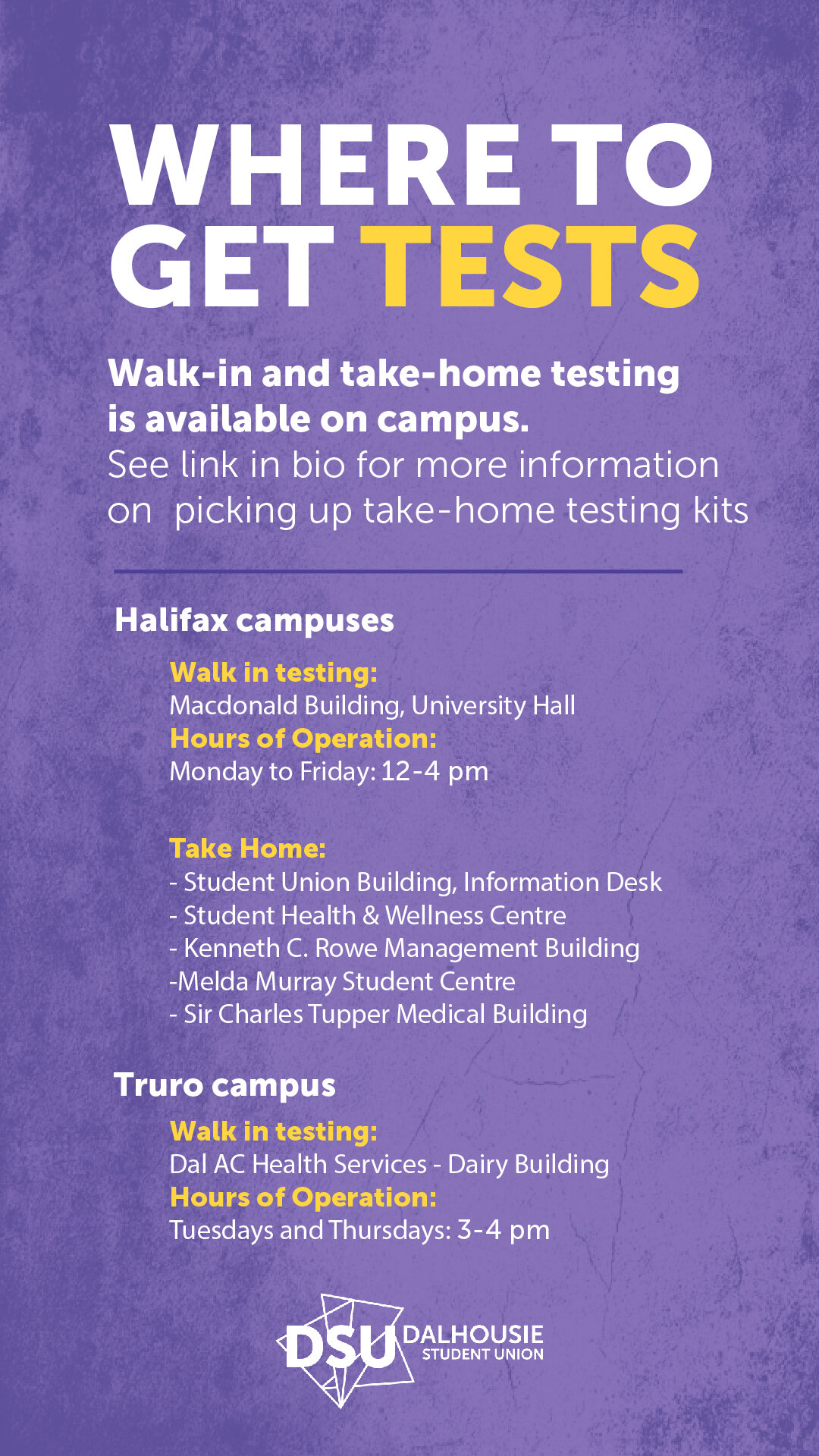
Walk in clinics and take home testing is available on campus. If you attended this weekend’s events, we are asking you to get tested regardless of your vaccination status. You can and should come pick up rapid test kits on campus.
Click below to find out hours and locations for on-campus testing sites.
Volunteer.
We need your help! Sign up to help assemble or distribute take-home testing kits. Once you’ve filled out the forms), you’ll be able to sign up for shifts.

DSU Statement on Housing Security and Police Violence
We need all levels of government to address the housing crisis with the same urgency it showed during its response to the COVID-19 pandemic. Housing is a human right which must be protected, and houselessness is a crisis which must not be punished.
DSU statement on housing security
and police violence in HRM
September 3, 2021

On August 18, 2021, the Halifax Regional Police carried out orders from the Halifax Regional Municipality to forcibly evict and fine houseless people living in temporary housing and crisis shelters made by Halifax Mutual Aid and community members.
During these evictions, citizens of Halifax, including students of Dalhousie, came together to stand in solidarity with our community and to advocate for access to affordable housing. As a response to community action, the Halifax Regional Police used excessive force including violent arrests, pepper spray, and full riot gear as weapons against protestors.
The Dalhousie Student Union, on behalf of our 18,000 members, condemns the violence enacted by the HRP as well as the lack of action taken by the HRM in response to this violence. Ordering mass evictions and the destruction of temporary shelters will not solve the housing crisis. These actions are a poorly concealed attempt to hide the housing crisis in our city, and students stand among the many community members who are appalled by the HRM and its police force’s decision to escalate the situation. The municipality’s response to houselessness cannot be removing crisis shelters, but rather must be the investment into long-term solutions to address housing insecurity and houselessness. All community members in this city deserve housing.
The DSU calls on the Halifax Regional Municipality and the Halifax Regional Police to immediately cease the evictions of houseless people from temporary shelters in Halifax and the destruction or removal of any temporary shelters that are created in this city. We call on the municipal government and police to revoke all fines issued to individuals occupying temporary shelters on August 18th, as well as all charges or fines issued to community members protesting the evictions of houseless people from shelters on August 18th.
Furthermore, we call on the provincial government to work with the HRM to put permanent protections in place for those occupying temporary shelters in Halifax as a first step to recognizing the reality of the housing crisis in this city. The government must protect rather than destroy these short-term, lifesaving measures that community members are creating for their houseless neighbors. This is the bare minimum response that community members need from our government.
This is not enough, however. We also call on the provincial government to immediately instate permanent rent control in Nova Scotia. More of our community members, particularly students, are in danger of becoming houseless due to the low vacancy rate and sky-rocketing rental prices in this city. The government is prepared to lift the rent cap put in place during the state of emergency due to COVID-19, but what the events on August 18th have highlighted to all of us is that the housing crisis in Halifax is not over. The housing crisis, which is already a dire situation, will become dramatically worse upon the removal of the 2% rent cap.
Students and community members need permanent rent control now. We need all levels of government to address the housing crisis with the same urgency it showed during its response to the COVID-19 pandemic. Housing is a human right which must be protected, and houselessness is a crisis which must not be punished.

Open Letter to Provincial Party Leaders
We need a government that will invest in the future of young people in this province. We're sending an open letter to our party leaders calling on them to prioritize the needs of students.
Students Need Action:
Open Letter to Provincial Party Leaders
August 13, 2021
To: The Right Honorable Iain Rankin, Tim Houston, Gary Burrill, and Jessica Alexander
Dear Party Leaders,
As we approach an election in Nova Scotia, post-secondary students across the province want to know what your party’s commitment to young people will be if elected. Students and young people continue to be left behind in platforms as well in practice. We need a government that will invest in the future of young people in this province.
On behalf of over 19,000 students studying at Dalhousie University, as well as other student organizations in Kjipuktuk/Halifax, we are calling on the party elected in August to commit to the following:
1. Funding for Post-Secondary Education
Nova Scotia has had the fasting rising rates of tuition in the country for almost a decade, and currently has the highest tuition fees in this country. The memorandum of understanding between the Province of Nova Scotia and the province’s universities states that each institution’s operating grant will increase by “not less than (1%) from the previous year” on a yearly basis. This mandated 1% increase is insufficient when faculty salaries, expenses, and inflation increase at faster rates. In other words, this so-called increase is effectively a cut to funding for post-secondary institutions in this province. In fact, post-secondary education in Nova Scotia has been chronically underfunded for decades.
Skyrocketing tuition fees are directly linked to the lack of government funding for post-secondary education. More and more of the costs of running and maintaining our universities are being offloaded onto students, but it does not have to be this way. Education is both a right and a necessity within today’s society and we need public investment in our public education system. Students need long-term, sustainable government funding for Post-Secondary Institutions in this province. This is a necessary step to move towards universally accessible education for all.
2. Affordable and Accessible Housing
Halifax is in a housing crisis and students are struggling. Vacancy rates in HRM are some of the lowest in the country, rental prices are increasing, the cost of education continues to rise, and the amount of housing that post-secondary institutions provide to students has decreased due to the COVID-19 pandemic. Students need accessible, safe, and affordable housing now.
Most students are renters and are therefore in need of renter protections including but not limited to permanent rent control. Permanent rent control cannot be the only solution, however, and cannot be done in a vacuum. All 95 recommendations in the “Keys to a Housing Secure Future For All Nova Scotians” report by the Housing for All Working Group must be implemented to ensure a holistic solution to the housing crisis which prioritizes those who are most disproportionately impacted by houselessness and housing insecurity—including women, 2SLGBTQIA+ people, African Nova Scotians, Indigenous peoples, migrants, and those with disabilities.
One of the key measures to ensure affordable housing for students is to increase the province’s minimum wage immediately, with the long-term goal of increasing it to a living wage. Additional income support must also be provided for Employment Support and Income Assistance (ESIA) recipients to close the poverty gap for those accessing these supports. Many of these recipients have disabilities, and it is vitally important that people with disabilities can access affordable housing that is also physically accessible.
3. Reconciliation with Indigenous Communities
It has been more than five years since the Truth and Reconciliation Commission’s report was published, and little progress has been made for Mi’kmaq and Indigenous students in Mi’kma’ki. The Nova Scotia government must implement all 94 Calls to Action in the TRC’s report, as well as all 231 Calls to Action in the final report of the National Inquiry into Missing and Murdered Indigenous Women, Girls, and 2SLGBTQQIA Peoples.
Specifically, students need the government to work with post-secondary institutions to implement the calls to action directly related to education. For those calls to action that are not directly under the authority of the province to implement, rather than dismissing them as “under federal jurisdiction” the Nova Scotia government must advocate relentlessly for the federal government to implement these calls to action, on behalf of Indigenous learners and communities in Mi’kma’ki. This includes the 11th call to action in the TRC’s report, which calls upon the federal government to provide adequate funding to end the backlog of First Nations students seeking a post-secondary education. Indigenous peoples need access to post-secondary education in Mi’kma’ki.
4. Addressing the Climate Crisis
The climate crisis is a serious threat not just for our future but for our present. We are already seeing the devastating effects of climate change on communities around the world in the form
of severe weather events such as wildfires. Immediate and bold government action is needed to address the climate crisis.
Students need the party elected this August to commit to building no new fossil fuel infrastructure, with the overarching aim of bringing Nova Scotia to 100% fossil fuel free by 2040 at the latest. The elected party must work to ensure that 90% of Nova Scotia’s electricity needs are supplied with renewable energy by 2030 and include a just transition for students and workers in high-carbon industries. Central to this work will be the establishment of a provincial Environmental Equity Working Group that includes a race-equity lens to environmental decision-making. In order to address the climate crisis, the provincial government must work directly with Mi’kmaq and African Nova Scotian communities.
5. Support for International Students and Migrants
International student and migrant voices must be heard this election season. International students and migrants contribute so much to Nova Scotian post-secondary institutions and economy, yet they pay exorbitant tuition fees—more than double the amount compared to domestic students—and are unable to immediately access health insurance when they arrive in Canada.
Post-secondary institutions cannot continue to be allowed to use international students as cash cows to sustain their institutions. We need the Nova Scotia government to regulate tuition fees in this province and eliminate differential fees for international students. The provincial government must also immediately provide Medical Services Insurance (MSI) to international students and migrants upon arrival. As a province in a country that prides itself on its free healthcare, it is unacceptable to make anyone wait to be able to access health insurance after they arrive in Nova Scotia. Moreover, all migrants—including international students with study permits—need full and permanent resident status now and universal access to provincial services.
We look forward to hearing how your party plans to adopt and address many of the student issues outlined above. As the population of youth continues to grow within this province, it is crucial that if elected, your party takes intentional steps to create and adopt the appropriate legislation to support a post-secondary learning environment that is accessible to all students and is reflective of our diverse needs. Students are the future of this province, accessible and high-quality of education are the foundation of this future.
Signed,
Dalhousie Student Union
Nova Scotia Public Interest Research Group (NSPIRG)
King’s Students’ Union
Canadian Federation of Students Nova Scotia

Navigating return to campus in the fall semester
With the fall semester quickly approaching and Nova Scotia reopening with support from the vaccine roll-out, many students have reached out with questions around in-person class delivery this fall. The DSU does not control the academic timetable or course delivery, but we are here to help and will continue to communicate students' concerns to the university.
Navigating return to campus in the fall semester
With the fall semester quickly approaching and Nova Scotia reopening with support from the vaccine roll-out, many students have reached out with questions about in-person class delivery this fall.
The DSU does not control the academic timetable or course delivery, but we are here to help and will continue to communicate students' concerns to the university. As of right now most classes are planned for in-person delivery, but some are being offered online. If you haven't already checked out the academic timetable, we encourage you to look and see how your courses are being delivered.
If you already know some or all of your classes will be online and you don't want to or can't come to campus this fall, the university has asked us to direct students to their specialized advising request form so you can be matched with an advisor from the Registrar's Office. This team of advisors may be able to help you find a way to meet your degree requirements online this year, so you can continue studying off campus. If you haven't seen it already, there is also an FAQ page on the Dalhousie website with more details about COVID-19 and courses.
If you are an international student having trouble with your visa application or travel plans to Canada, please contact the Dalhousie International Center for assistance.
You're not alone in your concerns for this fall and the DSU will continue to advocate for all students, both on and off campus. Student concerns are currently being brought to the university's Return to Campus Committee through the DSU President on an ongoing basis. A comprehensive update will be brought to Dalhousie's Board of Governors by our student representatives on June 22nd.
If you would like us to bring your concerns forward, please email dsupres@dal.ca.
DSU holding Reject the Fees rally on April 20th in response to tuition increase
Since the beginning of the COVID-19 pandemic, students at Dalhousie University and other post-secondary institutions across the province, have been asking both their institutions and provincial government to provide better supports that will directly impact students.

For immediate release.
April 15, 2021
Since the beginning of the COVID-19 pandemic, students at Dalhousie University and other post-secondary institutions across the province, have been asking both their institutions and provincial government to provide better supports that will directly impact students.
In response to the proposed tuition fee increase announced by Dalhousie University on February 25, 2021, students at Dalhousie University and the University of King’s College are holding a rally to lobby the University to adopt the three asks of the Reject the Fees campaign:
Remove tuition fee increases and freeze tuition for all students
Develop a sustainable operating budget that moves towards universally affordable
and accessible educationLobby the provincial and federal government to increase funding for post-secondary institutions
To learn more about our campaign, visit dsu.ca/reject-the-fees.
The Reject the Fees rally will take place on Dalhousie University’s Studley Quad at 1:30 pm on April 20th.
For media inquiries:
Holly Edmonds
Communications and Outreach Coordinator
dsucomm@dal.ca | 902-494-6226
Quick facts:
·On February 25, 2021, Dalhousie University announced yet another 3% increase in tuition and an additional $1473 for international students.
In 2008 students in Nova Scotia successfully lobbied both university administrators and the provincial government for a three-year tuition freeze.
The Dalhousie University Board of Governors (BoG) will vote on the proposed 2021-22 budget at the
BoG meeting on April 20th.
Download media release PDF:

Open letter to the Dalhousie Budget Advisory Committee
On behalf of over 19,000 students studying at Dalhousie University, we are sharing our concerns regarding Dalhousie University’s proposed 2021/22 budget. At the beginning of the summer 2020 semester, the DSU and its members voiced concerns about the 3% tuition increase instated this past Fall, and the additional $1473 increase for International students.
Open letter to the Dalhousie Budget Advisory Committee
March 9, 2021
To: BAC Chair, acting Provost Frank Harvey, and Vice President Finance & Admin Gitta Kulczycki,
On behalf of over 19,000 students studying at Dalhousie University, we are sharing our concerns regarding Dalhousie University’s proposed 2021/22 budget. At the beginning of the summer 2020 semester, the DSU and its members voiced concerns about the 3% tuition increase instated this past Fall, and the additional $1473 increase for International students.
Since then, the DSU has continued to advocate for adequate support for students whose finances and wellbeing have been negatively impacted by the pandemic and increased university fees. The DSU is recommending that Dalhousie do the following:
Remove all tuition increases and freeze tuition for both domestic and international students.
Develop a sustainable budget that moves towards universally accessible education.
Lobby the provincial and federal government to increase funding for post-secondary institutions.
Remove all tuition increases and freeze tuition for both domestic and international students.
Students on campus continue to voice concerns about the rising cost of tuition and financial barriers attached to accessing post-secondary education. When quarantine restrictions were implemented across the globe last March, the precarious nature of students’ financial realities only heightened. Many students faced and continue to face loss of employment, food insecurity and increasing anxiety given the global uncertainty.
International students in Nova Scotia continue to pay upwards of $19, 000 and climbing each year, which is more than double the amount of tuition that their domestic peers pay.
Moreover, they have significantly less health care coverage, more barriers preventing them from accessing CERB and other financial assistance programs, and this year alone the both the province and the university has already required them to pay up to $1600 in hotel costs to return to Halifax, which was not required by students entering the province from other regions of Canada or Canadian students who were returning from an international trip.
Dalhousie prides itself on claiming to create a fair, diverse, and accessible community. Raising international student fees exorbitantly and defending the decision by comparing these fees to others in the country directly contradicts these claims. If Dalhousie wants to create a fair and accessible community on campus and online for the international community, they must prioritize the wellbeing of their current students who cannot continue to pay these rising fees.
As our one-year anniversary of the pandemic quickly approaches, a promising solution that caters to the immediate needs of students has yet to be presented. Imposing increases in tuition fees during a pandemic shows that Dalhousie University has not taken the necessary steps to address the financial concerns faced
by all students. Moreover, the lack of engagement with students about this issue and possible solutions is creating an environment of distrust between students and Dalhousie’s administration. Dalhousie can begin
to amend the divide by removing all proposed tuition increases for the 2021/2022 academic year and freezing tuition.
Develop a sustainable budget that moves towards universally accessible education.
Given the current global circumstances, Dalhousie is still projecting an increase in enrollment by 4.8%. Tuition currently makes up over 42% of Dalhousie current revenue, meaning students are the institution's second largest investor. To ensure our campus is equipped with the supports and services needed to create a healthy learning environment, Dalhousie must work alongside students, faculty and staff to ensure the budget is reflective of our needs.
The 2021-2022 draft budget included investments into a variety of grant and scholarship programs, such as the First Nations and Indigenous Black (FNIB) Student Scholarship.
Scholarships for marginalized groups must be maintained to assist groups who face systematic barriers when accessing post-secondary education. However, blanket scholarships intended to bridge the divide created by rising tuition fees are insufficient, largely because they can only be obtained by a fraction of the student population and at-risk students are falling through the system’s cracks. These funds should be used to decrease or stabilize current tuition and ancillary fees for all students.
Lobby the provincial and federal government to increase funding for post-secondary institutions.
We can work alongside each other and lobby the federal and provincial governments to increase their funding to post-secondary institutions. The current memorandum of understanding between the Province of Nova Scotia and the province’s universities states that each institution’s Operating Grant will increase by “not less than (1%) from the previous year” on a yearly basis. This mandated 1% increase is insufficient when faculty salaries, expenses, and inflation increase at faster rates.
In 2010/2011, 60% of Dalhousie University’s revenue was from government sources, with only 31% of revenue coming from tuition and fees. Last year, government funding (49%) barely edged out tuition and fee revenue (42%). More and more of the costs of running and maintaining our universities are being offloaded onto students. Education is both a right and a necessity within today’s society. We need public investment in our public education system. For us to maintain the development of innovative technology, we must ensure the institutions that fund them are adequately funded, and not at the expense of students.
In conclusion, we call on the Budget Advisory Committee to develop a 2021-2022 draft operating budget that does not include tuition fee and fee increases.
Furthermore, students want to see a longer timeframe for their feedback to be sought and considered by BAC. We ask that initial feedback be collected via email up until April 1, 2021 and frequent communications and updates are made available following the deadline.
Students need the University to step up and seriously consider a new path forward with this operating budget—one that is reflective of the long-term wellbeing of students and the need for accessible post-secondary education in our province and in this country.
Signed,

More information:
Canadian and international tuition fees by level of study: https://www150.statcan.gc.ca/t1/tbl1/en/tv.action?pid=3710004501
Budget Advisory Committee Report LX: https://cdn.dal.ca/content/dam/dalhousie/pdf/dept/financial- services/Reports/BAC%20Reports/Budget%20Advisory%20Committee%20Report%20LX.pdf
Download Open Letter PDF: https://static1.squarespace.com/static/5b460941a9e0285288d59058/t/604a154af28ab444bec91d0e/1615467850788/Letter+to+BAC.pdf