
DSU statement on unsanctioned Halifax street parties
This weekend’s large, off-campus homecoming parties have made waves across the community, and the time has come for an open discussion on their impacts. We can and must do better in the future, so, let’s talk about what happens next.
September 27, 2021
To our Dalhousie students and community,
This weekend’s large, off-campus homecoming parties have made waves across the community, and the time has come for an open discussion on their impacts. We can and must do better in the future, so, let’s talk about what happens next.
We must all acknowledge that hosting this party during the COVID-19 pandemic put students and community members, double-vaccinated or not, at risk of contracting a life-threatening virus. We know that this has been a long, isolating, period and that everyone is eager to get back to normal. We are allowed to grieve for the experiences that were lost because of COVID-19. Still, the reality remains that we are in a pandemic and we must behave accordingly to keep everyone safe. It may seem unfair, but we are all being held to a higher standard because of COVID-19.
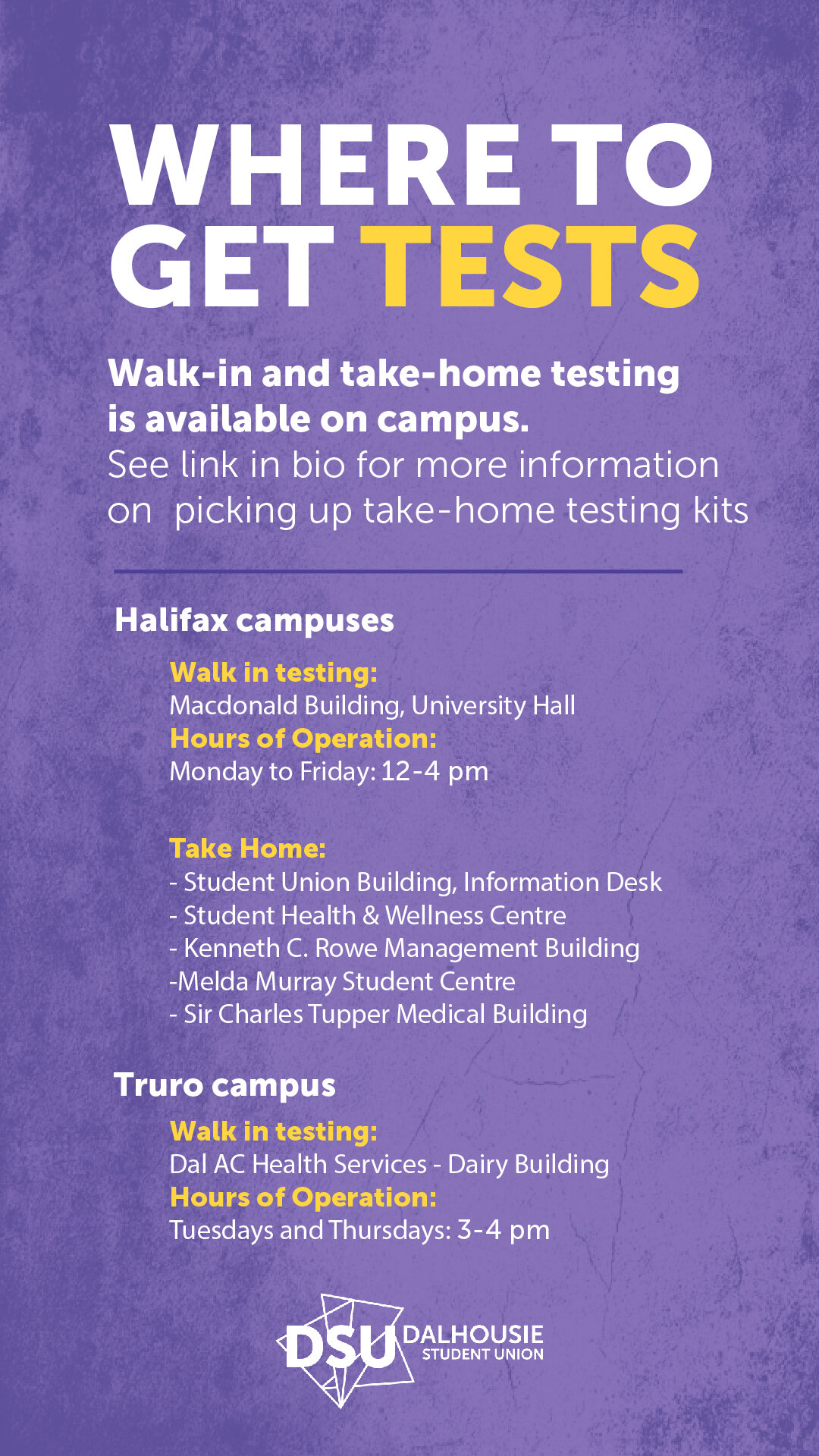
If you did attend this weekend’s events, we are asking you to get tested regardless of your vaccination status. Dalhousie is asking attendees to stay home and monitor their symptoms until October 4th. You can and should come to campus to pick up rapid test kits. Our actions in the coming weeks will be vital to limiting the public health impact of this weekend.
We understand that students are going to party. Social gatherings are a part of many students’ university experiences and are an important part of how we find community. It is also true, however, that those who live in our community are rightfully upset about property destruction, not being able to leave or return to their homes, and the strain placed on Halifax’s emergency services.
The actions of some students this weekend do not represent the values of students at large, and we will have to work to repair damaged relationships. We will not see news stories about the students who went out after the party to collect trash, those who volunteered on campus, or who found other ways to celebrate. To those students, we see you and we thank you.
Some individuals who attended this weekend’s parties may be disciplined by Dalhousie through the Student Code of Conduct. If you find yourself in this position, you can contact student advocates at the Dalhousie Student Advocacy Service (dsas@dal.ca), which is a service funded by the DSU. These advocates can help navigate the process of responding to a Student Code of Conduct violation. Everyone deserves fair, due, and informed procedure.
The DSU is here to support all students. We will work with DSAS to ensure that students have fair violation hearings. We will also support students who are upset with their peers, by calling on them to do better. We will continue to connect with Dalhousie to emphasize the importance of harm reduction programming and an educational focus on discipline.
In future years, we believe it is crucial that Dalhousie University play a stronger role in providing alternative programming for our students. With an influx of students on campus, it is imperative that Dalhousie University work with students and community members to develop programming that highlights the importance of safety, consent, and harm reduction. If the University wants to welcome 20,000 students to Halifax, it must respond by providing engaging activities to encourage students to stay on-campus to celebrate without being penalized. We must also discuss the harms of bans on alcohol in residence, which drive students off campus, in to the community, and away from supports and services.
In the coming weeks, the DSU is working to lead an extremely large, community-wide effort to increase access to rapid testing. All students are welcome to volunteer. We thank those of you who continue to prioritize the wellbeing of our community. Please know that this conversation will continue as an open dialogue, and that the DSU hopes to represent students in conversations about the future of homecoming.
If you are a student and would like to share your thoughts, please email DSU President Madeleine Stinson at dsupres@dal.ca.
Let’s do our part.
Get tested.
Walk in clinics and take home testing is available on campus. If you attended this weekend’s events, we are asking you to get tested regardless of your vaccination status. You can and should come pick up rapid test kits on campus.
Click below to find out hours and locations for on-campus testing sites.
Volunteer.
We need your help! Sign up to help assemble or distribute take-home testing kits. Once you’ve filled out the forms), you’ll be able to sign up for shifts.
DSU holding Reject the Fees rally on April 20th in response to tuition increase
Since the beginning of the COVID-19 pandemic, students at Dalhousie University and other post-secondary institutions across the province, have been asking both their institutions and provincial government to provide better supports that will directly impact students.

For immediate release.
April 15, 2021
Since the beginning of the COVID-19 pandemic, students at Dalhousie University and other post-secondary institutions across the province, have been asking both their institutions and provincial government to provide better supports that will directly impact students.
In response to the proposed tuition fee increase announced by Dalhousie University on February 25, 2021, students at Dalhousie University and the University of King’s College are holding a rally to lobby the University to adopt the three asks of the Reject the Fees campaign:
Remove tuition fee increases and freeze tuition for all students
Develop a sustainable operating budget that moves towards universally affordable
and accessible educationLobby the provincial and federal government to increase funding for post-secondary institutions
To learn more about our campaign, visit dsu.ca/reject-the-fees.
The Reject the Fees rally will take place on Dalhousie University’s Studley Quad at 1:30 pm on April 20th.
For media inquiries:
Holly Edmonds
Communications and Outreach Coordinator
dsucomm@dal.ca | 902-494-6226
Quick facts:
·On February 25, 2021, Dalhousie University announced yet another 3% increase in tuition and an additional $1473 for international students.
In 2008 students in Nova Scotia successfully lobbied both university administrators and the provincial government for a three-year tuition freeze.
The Dalhousie University Board of Governors (BoG) will vote on the proposed 2021-22 budget at the
BoG meeting on April 20th.
Download media release PDF:

Open letter to the Dalhousie Budget Advisory Committee
On behalf of over 19,000 students studying at Dalhousie University, we are sharing our concerns regarding Dalhousie University’s proposed 2021/22 budget. At the beginning of the summer 2020 semester, the DSU and its members voiced concerns about the 3% tuition increase instated this past Fall, and the additional $1473 increase for International students.
Open letter to the Dalhousie Budget Advisory Committee
March 9, 2021
To: BAC Chair, acting Provost Frank Harvey, and Vice President Finance & Admin Gitta Kulczycki,
On behalf of over 19,000 students studying at Dalhousie University, we are sharing our concerns regarding Dalhousie University’s proposed 2021/22 budget. At the beginning of the summer 2020 semester, the DSU and its members voiced concerns about the 3% tuition increase instated this past Fall, and the additional $1473 increase for International students.
Since then, the DSU has continued to advocate for adequate support for students whose finances and wellbeing have been negatively impacted by the pandemic and increased university fees. The DSU is recommending that Dalhousie do the following:
Remove all tuition increases and freeze tuition for both domestic and international students.
Develop a sustainable budget that moves towards universally accessible education.
Lobby the provincial and federal government to increase funding for post-secondary institutions.
Remove all tuition increases and freeze tuition for both domestic and international students.
Students on campus continue to voice concerns about the rising cost of tuition and financial barriers attached to accessing post-secondary education. When quarantine restrictions were implemented across the globe last March, the precarious nature of students’ financial realities only heightened. Many students faced and continue to face loss of employment, food insecurity and increasing anxiety given the global uncertainty.
International students in Nova Scotia continue to pay upwards of $19, 000 and climbing each year, which is more than double the amount of tuition that their domestic peers pay.
Moreover, they have significantly less health care coverage, more barriers preventing them from accessing CERB and other financial assistance programs, and this year alone the both the province and the university has already required them to pay up to $1600 in hotel costs to return to Halifax, which was not required by students entering the province from other regions of Canada or Canadian students who were returning from an international trip.
Dalhousie prides itself on claiming to create a fair, diverse, and accessible community. Raising international student fees exorbitantly and defending the decision by comparing these fees to others in the country directly contradicts these claims. If Dalhousie wants to create a fair and accessible community on campus and online for the international community, they must prioritize the wellbeing of their current students who cannot continue to pay these rising fees.
As our one-year anniversary of the pandemic quickly approaches, a promising solution that caters to the immediate needs of students has yet to be presented. Imposing increases in tuition fees during a pandemic shows that Dalhousie University has not taken the necessary steps to address the financial concerns faced
by all students. Moreover, the lack of engagement with students about this issue and possible solutions is creating an environment of distrust between students and Dalhousie’s administration. Dalhousie can begin
to amend the divide by removing all proposed tuition increases for the 2021/2022 academic year and freezing tuition.
Develop a sustainable budget that moves towards universally accessible education.
Given the current global circumstances, Dalhousie is still projecting an increase in enrollment by 4.8%. Tuition currently makes up over 42% of Dalhousie current revenue, meaning students are the institution's second largest investor. To ensure our campus is equipped with the supports and services needed to create a healthy learning environment, Dalhousie must work alongside students, faculty and staff to ensure the budget is reflective of our needs.
The 2021-2022 draft budget included investments into a variety of grant and scholarship programs, such as the First Nations and Indigenous Black (FNIB) Student Scholarship.
Scholarships for marginalized groups must be maintained to assist groups who face systematic barriers when accessing post-secondary education. However, blanket scholarships intended to bridge the divide created by rising tuition fees are insufficient, largely because they can only be obtained by a fraction of the student population and at-risk students are falling through the system’s cracks. These funds should be used to decrease or stabilize current tuition and ancillary fees for all students.
Lobby the provincial and federal government to increase funding for post-secondary institutions.
We can work alongside each other and lobby the federal and provincial governments to increase their funding to post-secondary institutions. The current memorandum of understanding between the Province of Nova Scotia and the province’s universities states that each institution’s Operating Grant will increase by “not less than (1%) from the previous year” on a yearly basis. This mandated 1% increase is insufficient when faculty salaries, expenses, and inflation increase at faster rates.
In 2010/2011, 60% of Dalhousie University’s revenue was from government sources, with only 31% of revenue coming from tuition and fees. Last year, government funding (49%) barely edged out tuition and fee revenue (42%). More and more of the costs of running and maintaining our universities are being offloaded onto students. Education is both a right and a necessity within today’s society. We need public investment in our public education system. For us to maintain the development of innovative technology, we must ensure the institutions that fund them are adequately funded, and not at the expense of students.
In conclusion, we call on the Budget Advisory Committee to develop a 2021-2022 draft operating budget that does not include tuition fee and fee increases.
Furthermore, students want to see a longer timeframe for their feedback to be sought and considered by BAC. We ask that initial feedback be collected via email up until April 1, 2021 and frequent communications and updates are made available following the deadline.
Students need the University to step up and seriously consider a new path forward with this operating budget—one that is reflective of the long-term wellbeing of students and the need for accessible post-secondary education in our province and in this country.
Signed,

More information:
Canadian and international tuition fees by level of study: https://www150.statcan.gc.ca/t1/tbl1/en/tv.action?pid=3710004501
Budget Advisory Committee Report LX: https://cdn.dal.ca/content/dam/dalhousie/pdf/dept/financial- services/Reports/BAC%20Reports/Budget%20Advisory%20Committee%20Report%20LX.pdf
Download Open Letter PDF: https://static1.squarespace.com/static/5b460941a9e0285288d59058/t/604a154af28ab444bec91d0e/1615467850788/Letter+to+BAC.pdf